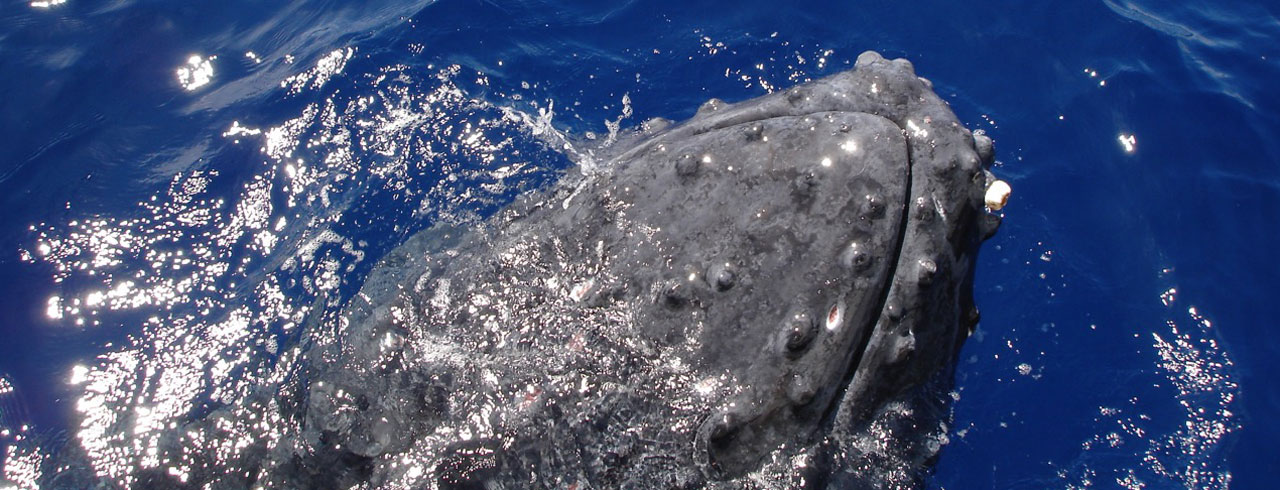
Increasing noise pollution, in the form of underwater explorations for oil or gas, ships, air guns or newly developed underwater sonar systems, is affecting the navigational abilities of the whales. The 'LFAS' (low frequency active sonar) is able to detect quiet vessels and therefore it produces extremely loud sound waves (up to 235 db!). All this could be linked to the increasing number of marine mammal strandings. Imagine this: for the human ear a sound level of 'just' 85 db is meant to be dangerous...
| Download | Name | Play | Size | Length |
|
Household Light Bulb When a household light bulb is dropped overboard with a rock attached, it will self-implode at a depth of about 100 meters, producing an impulsive sound. This recording is of such an implosion in 2400 m water depth where the echoes are distinctive corresponding to the water depth and hydrophone depth. Ocean acousticians sometimes use this technique as an inexpensive sound source |
|
0.2 MB | 0:26 min |
|
Low Frequency Active Sonar Low Frequency Active Sonar (LFA) recorded in 1994 off Washington state while the Navy source ship was transmitting off San Diego about 1000 miles distant |
|
0.2 MB | 0:35 min |
|
Low Frequency Active Sonar The 'LFAS' (low frequency active sonar) is able to detect quiet vessels and therefore it produces extremely loud sound waves (up to 235 db!) |
|
0 MB | 0:05 min |
|
Merchant Vessel The sound of a large merchant vessel at a few miles in choppy seas as recorded on a sonobuoy |
|
0.4 MB | 1:03 min |
|
NOAA research vessel The sound of the 52 m NOAA research vessel MacArthur at about 3/4 mile range in calm seas as recorded on a sonobuoy |
|
0.4 MB | 1:00 min |
|
Sonar Ping |
|
0 MB | 0:06 min |
| Joomla! web design... | ||||